Carbon Fiber vs Fiberglass Pickleball Paddles
Carbon fiber and fiberglass paddles play very differently. Here is exactly which face material suits your game, skill level, and budget.
Carbon fiber and fiberglass paddles play very differently. Here is exactly which face material suits your game, skill level, and budget.
Affiliate disclosure: This article contains affiliate links. Paddlory earns a commission if you purchase through links at no added cost to you.
Carbon fiber paddles generate more spin and give you a stiffer, faster response off the face; fiberglass paddles flex slightly on contact, which translates to a softer feel and a bigger natural sweet spot. Neither material is universally better. The right call depends on whether you prioritize control and touch or power and spin production.
Most players feel the difference within the first rally. Carbon fiber is unforgiving of off-center hits and rewards a compact, deliberate swing. Fiberglass absorbs just enough energy to give recreational and intermediate players more margin for error. Both surfaces sit over a polymer honeycomb core, so core density ultimately shapes how much of that face-material character you actually feel.
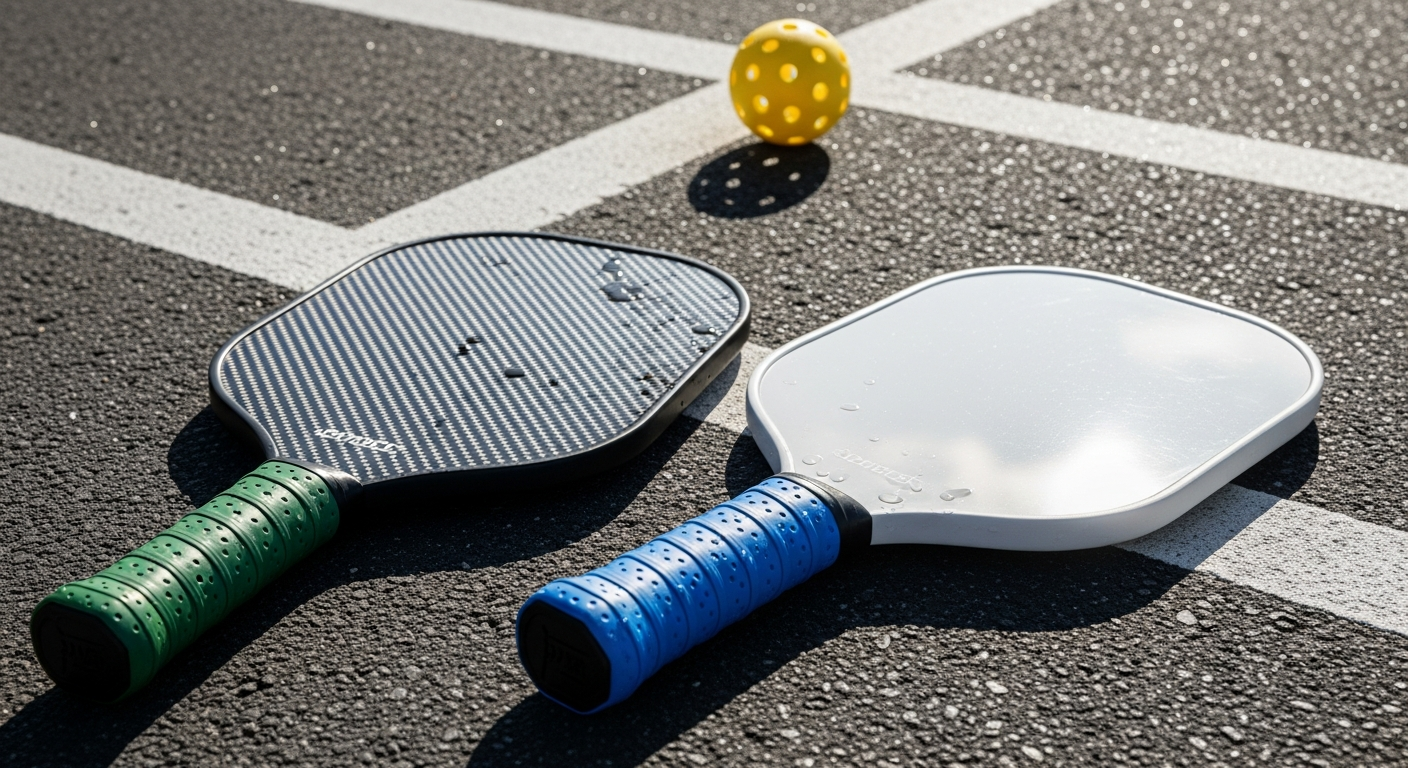
Carbon fiber (also labeled “carbon” or “raw carbon”) is a woven composite sheet layered over the paddle core. Its stiffness coefficient runs roughly 2 to 3 times higher than E-glass fiberglass, which means the face deforms very little at ball contact. That stiffness produces two measurable on-court effects: higher spin potential because the texture grips the ball without compressing, and a crisper, faster response because energy returns quickly. The tradeoff is reduced dwell time; the ball leaves the surface before you can redirect it on mishits. Fiberglass (E-glass composite) bends slightly under contact, giving the ball about 5 to 8 milliseconds more dwell time than a comparable carbon face paddle. That extra dwell is what players describe as “softer” or “more forgiving.” You feel it most on kitchen resets and drop shots, where you want the ball to die off the paddle rather than pop back.
The most immediate thing you notice with a carbon face is the texture. Raw carbon has a gritty, almost sandpaper-like surface that grabs the ball on contact. At the 2025 APP and PPA tours, most top-50 players used carbon-face paddles because that surface generates measurable topspin and backspin on drives and dinks. Independent lab testing by Pickleball Effect measured spin rates of 1,850 to 2,100 RPM on a standard drive with a textured carbon face versus 1,400 to 1,600 RPM on a smooth fiberglass face under identical swing conditions.
Stiffness also means the sweet spot is smaller than marketing language typically admits. Hits within the central 40% of the face feel authoritative. Catches toward the edge or near the throat return noticeably different feedback. If you center the ball consistently, that is a strength. If your contact point wanders, that variance gets punished.
Most carbon face paddles today pair the face with a 16mm polypropylene honeycomb core for control builds or a 13mm core for power-oriented builds. The best control, power, and spin paddles section on this site shows current models sorted by that core-thickness variable, worth reviewing once you narrow to carbon.
Fiberglass paddles dominated the entry and intermediate market for most of pickleball’s early growth, and they still make sense for a large segment of players. The flex creates a trampoline effect that helps less aggressive swing mechanics generate pace. You do not need to swing through the ball as hard to get depth on drives. That characteristic makes fiberglass a natural fit if you are coming from tennis and still learning to shorten your backswing. The dwell advantage shows up most clearly on soft game. When you reset a hard-hit ball at the kitchen, a fiberglass face absorbs a share of the incoming pace instead of returning it, making blocking and resetting more consistent without requiring near-perfect technique. Many 3.0 to 3.5 DUPR players report that switching from fiberglass to carbon cost them 10 to 15 unforced errors per session until they adjusted their touch, which is a real adaptation cost worth weighing before you commit to carbon.
One area where fiberglass genuinely underperforms is spin. The smoother surface and the flexing action both reduce the paddle’s ability to grip and roll the ball. If you want heavy topspin on your third-shot drop or to pull opponents wide with heavy cross-court dinks, a fiberglass face will limit that ceiling.
For budget-conscious players, fiberglass paddles at the $60 to $100 range perform closer to their $150 carbon counterparts than you might expect. The material cost difference at volume production runs roughly $8 to $12 per paddle, but retail markup on carbon runs much higher because of brand positioning.
| Attribute | Carbon Fiber Face | Fiberglass Face |
|---|---|---|
| Face stiffness | High (less deflection at contact) | Moderate (flex trampoline effect) |
| Spin potential | High (textured grit grips ball) | Low to moderate (smoother face) |
| Sweet spot size | Smaller, more defined | Larger, more forgiving |
| Dwell time | Short (fast response) | Longer (more feel on touch shots) |
| Power output | High with controlled mechanics | Moderate to high (trampoline assist) |
| Off-center forgiveness | Lower | Higher |
| Typical price range | $90 to $250+ | $40 to $150 |
| Best for skill level | 3.5 DUPR and above | 2.5 to 3.5 DUPR |
| Temperature sensitivity | Low (stable across temps) | Moderate (softens in heat) |
The decision comes down to two questions: how consistent is your contact point, and where do you most often lose points? Choose carbon fiber if you are at 3.5 DUPR or higher, you want to add spin to your arsenal, your losses mostly come from opponents attacking you rather than from your own unforced errors, and you are willing to spend two to four sessions adapting your touch game. Choose fiberglass if you are building your game below 3.5 DUPR, your unforced error count is higher than your opponent-error count, you play three or fewer times per week and want a paddle that performs consistently without intensive adaptation, or you want a quality paddle under $100 that will not punish off-center hits. A third camp is worth naming: players who play aggressively at the kitchen and prioritize resets. Some 4.0+ players stay on fiberglass for the dwell advantage in the soft game, accepting the spin tradeoff.
Once you know which material suits your game, the next variable is weight. The pickleball paddles buyer’s guide covers how weight interacts with swing speed and arm fatigue across both face materials.
A growing number of paddles use hybrid construction where a thin carbon weave bonds over a fiberglass base, or where the entire structure is thermoformed under heat and pressure rather than cold-press bonded. Thermoformed carbon paddles, marketed by brands like Joola, Six Zero, and Selkirk, produce measurably higher ball speeds because the face and core bond more rigidly. USAPA testing showed that some early thermoformed models exceeded the deflection thresholds in the equipment approval standards, leading to several high-profile delistings in 2023 and 2024.
Check current USAPA approval status before buying any thermoformed paddle. The approved equipment list updates monthly.
Carbon fiber faces wear in a way that is worth tracking. The gritty texture that generates spin degrades over time, particularly if you play outdoors where grit contacts the face. Most touring players replace paddles every three to six months because of spin degradation. At recreational pace, a carbon face typically holds full spin performance for 12 to 18 months of two-to-three-times-weekly play. Fiberglass is more durable in this regard; face properties change less over time because the trampoline effect comes from composite flexing rather than surface texture. Fiberglass faces can delaminate under sustained moisture, but for most recreational players buying one paddle for several years, fiberglass holds up better as a long-term investment.
No. Carbon fiber excels at spin generation and stiff, fast response, which suits players at 3.5 DUPR and above with consistent mechanics. Below that level, the smaller sweet spot and shorter dwell time often increase unforced errors. Fiberglass provides more forgiveness and a larger effective sweet spot, which outweighs carbon’s advantages for developing players.
Yes, but with a real adaptation cost. Carbon faces punish off-center hits more than fiberglass. Most beginners who start on carbon spend their first several sessions fighting inconsistency that a fiberglass paddle would have absorbed. A fiberglass paddle in the $60 to $100 range is a more efficient learning tool for the first six to twelve months.
The spin-generating surface texture on carbon faces degrades over time, typically faster than fiberglass properties change. Competitive players replace carbon paddles every three to six months. At recreational frequency (two to three times weekly), a carbon face holds performance for roughly 12 to 18 months before spin generation noticeably drops. Fiberglass paddle properties are more stable over a longer ownership period.
The manufacturing cost difference between faces is roughly $8 to $12 per paddle. At retail, carbon face paddles typically run $90 to $250 or more, while comparable fiberglass paddles sit between $40 and $150. The premium for carbon reflects brand positioning as much as material cost. Quality fiberglass paddles at the $80 to $100 range often outperform budget carbon paddles at the same price point.
Yes. Thermoformed paddles bond the face and core under heat and pressure, creating a stiffer overall structure that produces higher ball speed than cold-press carbon. Some thermoformed models have been removed from the USAPA approved equipment list for exceeding deflection thresholds. If you are playing in sanctioned tournaments, confirm current USAPA approval status before purchasing any thermoformed paddle.
The majority of top PPA and APP tour professionals use carbon or thermoformed carbon paddles as of 2025 and 2026. Some players at the recreational and amateur competitive level (3.0 to 4.0 DUPR) prefer fiberglass for the dwell advantage on kitchen play. Fiberglass is not a pro-level choice in current competitive pickleball, though it remains a strong option for players who prioritize consistency over spin.
Once you know which face material fits your game, compare specific models in the best pickleball paddles tested and ranked list, broken down by skill level and playing style. If your budget is under $150, that category has its own dedicated best paddles under $150 review with current picks across both face materials.
About the author: Eli Carter has been playing pickleball for four years, currently competing at the 3.5 recreational level. He tests paddles across both indoor and outdoor hard courts and writes about gear with a focus on helping players make practical decisions without wading through marketing copy.
Last updated: June 20, 2026
Ratings marked "pending" indicate on-court testing has not yet been completed.