Pickleball Paddle Weight Guide: How to Choose
Paddle weight shapes swing speed, power, and arm fatigue more than any other spec. Here is how to pick the right weight for your game.
Paddle weight shapes swing speed, power, and arm fatigue more than any other spec. Here is how to pick the right weight for your game.
Affiliate disclosure: This article contains affiliate links. Paddlory earns a commission if you purchase through links at no added cost to you.
Pickleball paddles fall into three weight categories: lightweight (under 7.5 oz), midweight (7.5 to 8.2 oz), and heavyweight (above 8.2 oz). Lightweight paddles favor quick hands and arm health; heavyweight paddles drive the ball deeper with less effort. Most recreational players land in the midweight range, but the right call depends on your swing mechanics, how many hours per week you play, and whether you already have elbow or shoulder issues.
Weight is the single spec that affects how a paddle feels more than face material, core thickness, or grip size combined. A half-ounce difference, about the weight of a AA battery, is noticeable within five minutes of play.
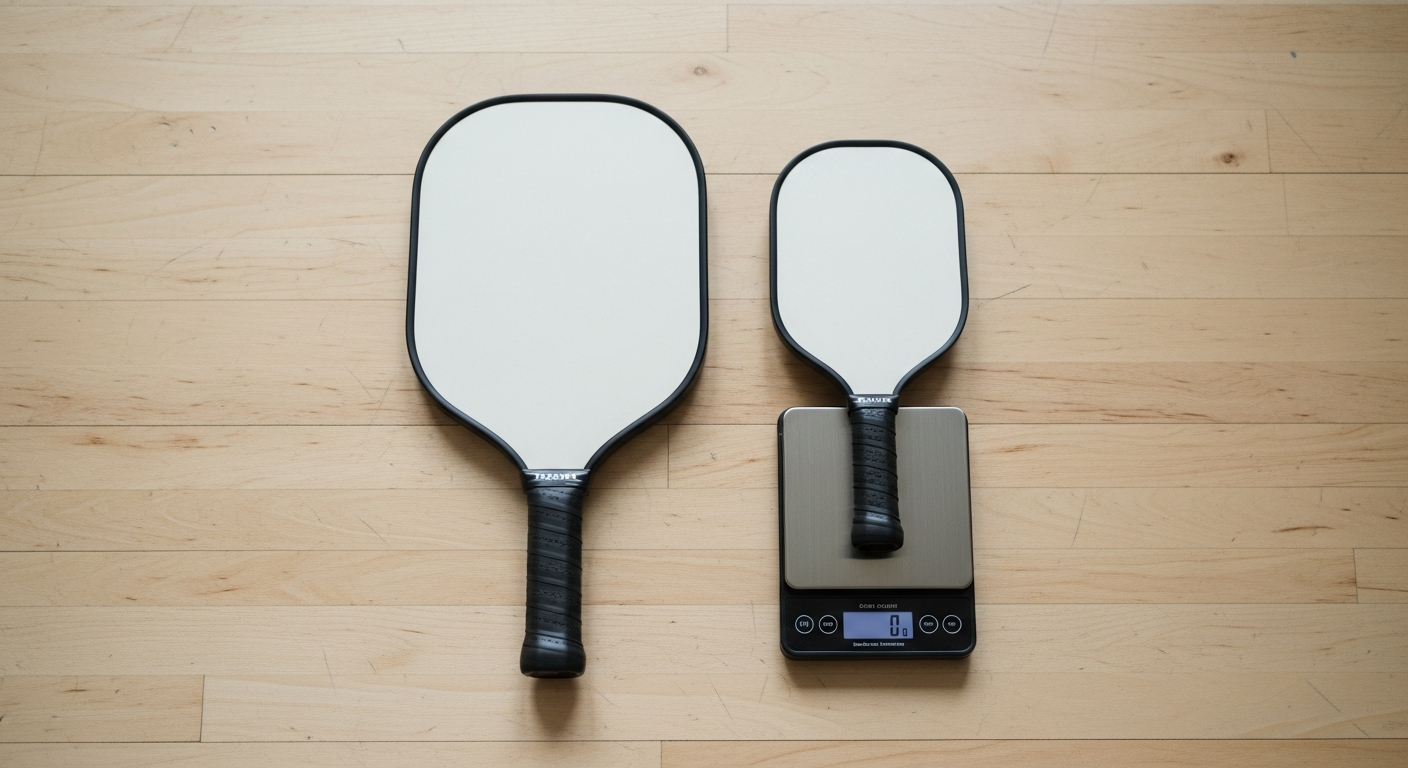
Paddle weight affects three things simultaneously: swing weight (how the paddle feels mid-swing, influenced by where the mass sits), power output (heavier paddles transfer more momentum to the ball on drives), and arm load (heavier paddles accelerate fatigue and increase joint stress over repeated sessions). These three factors pull in different directions. More weight means more power but more fatigue. Less weight means faster hands but less drive depth without additional swing effort. Swing weight is not the same as static weight; a paddle that is heavier toward the tip generates more power than the same paddle with mass centered in the handle, even at identical static weights. Manufacturers rarely publish swing weight figures directly, but balance point descriptions (head-heavy, even-balance, handle-heavy) give you the same information. A head-heavy 7.8 oz paddle can feel heavier in play than an even-balance 8.1 oz paddle of a different shape.
Paddles in this range are built for speed and arm protection. When your opponent drives from 7 feet away at the kitchen line, you have roughly 180 to 220 milliseconds to respond. A lighter paddle redirects with less rotational inertia, which matters most on fast net exchanges.
The arm health case for lightweight is strong. A 2022 study in the Journal of Sport Rehabilitation identified repetitive loading from heavier implement use as a contributing factor in lateral epicondylitis (tennis elbow) among recreational racket sport players. Players with elbow tendinopathy or rotator cuff issues consistently report less pain with paddles under 7.3 oz. The reduced lever-arm force per swing is meaningful over hundreds of swings per session.
The tradeoff is drive depth. Lightweight paddles demand you generate pace through swing speed rather than mass transfer. Players who thrive with them tend to have quick, loose wrists and rely on placement and spin rather than raw power. If your swing mechanics are compact or your arm strength is limited, drives may land shorter than you want.
This is where the majority of quality paddles cluster, and for good reason. The midweight range balances power and maneuverability well enough that most players do not need to look outside it. Paddles at 7.6 to 7.9 oz feel lively without becoming fatiguing over a two-hour session. Paddles at 8.0 to 8.2 oz carry enough mass to drive the ball with authority without demanding a full shoulder turn on every shot. The 7.8 oz paddle is something of an industry reference point. Many brands issue their flagship models at 7.8 oz because it sits near the midpoint of the midweight range and tests well across diverse player profiles. One pattern worth knowing: the same paddle model often shows weight variance of plus or minus 0.3 oz between individual units due to manufacturing tolerances. If exact weight matters to you, weigh the paddle yourself before buying.
Tennis converts often find the 8.0 to 8.2 oz range immediately familiar; full tennis rackets weigh 10 to 12 oz strung, so even heavy pickleball paddles feel light. The bigger adjustment is grip size and swing length, not weight.
Paddles above 8.2 oz are built for baseliners who want maximum drive depth. At equivalent swing speeds, an 8.8 oz paddle sends the ball measurably deeper than a 7.5 oz paddle, all else equal.
The problems surface across a longer session. By game three, reaction time at the net slows noticeably. Heavy paddles amplify vibration on off-center hits, which can irritate elbow issues even without diagnosed tendinopathy. Adding lead tape to a midweight paddle is usually a better path; 0.1 oz increments let you find your threshold before committing to a new paddle.
| Player Type | Recommended Weight | Reason |
|---|---|---|
| New player (first paddle) | 7.6 to 8.0 oz | Enough mass for drive depth without overloading swing mechanics |
| Tennis or racquetball convert | 7.8 to 8.2 oz | Closest to familiar implement weight; easier adjustment |
| Kitchen-line specialist | 7.3 to 7.7 oz | Speed of hands at net matters more than drive depth |
| Baseline power player | 8.0 to 8.8 oz | Mass transfer on drives; less reliance on swing speed |
| Player with elbow or shoulder issues | Under 7.3 oz | Reduced lever-arm stress per swing across long sessions |
| Senior or reduced-strength player | 7.0 to 7.5 oz | Arm fatigue is cumulative; lighter paddle extends comfortable play time |
| Competitive 4.0+ DUPR | 7.6 to 8.0 oz | Balance of speed and power; weight fine-tuned via lead tape |
Weight does not operate in isolation. A 7.8 oz paddle with a 4.5-inch grip plays differently than the same weight at 4.0 inches, because grip size affects wrist force transfer. Smaller grips allow more wrist action; players who snap their wrists prefer 4.0 to 4.25 inches, while players who drive from the shoulder prefer larger ones.
Core thickness compounds the effect. A 16mm polypropylene core feels slower and more controlled than a 13mm core at the same static weight, even though the scale reading is identical. When comparing paddles at the same weight, always ask about core thickness. The full breakdown is in the complete paddle selection guide.
Lead tape strips (sold in 1/4-inch and 1/2-inch widths) let you add weight in increments as small as 0.1 oz. Tape added at the top edge increases head-heaviness and swing weight, boosting power on drives; tape along the side edges widens the effective sweet spot; tape at the handle reduces swing weight and improves maneuverability. A practical starting protocol: add two 2-inch strips to the top edge and play one full session. If it feels better, add two more strips and repeat. Stop when the power benefit no longer outweighs the arm fatigue. Most players find their preferred feel within 0.3 to 0.5 oz of added tape. A roll costs about $10, making it the lowest-cost way to test weight preferences before committing to a different paddle. Keep a note of how many strips you added and where; you will want that data when you eventually buy a new paddle and try to replicate the feel.
The most reliable test is borrowed court time with a paddle at your target weight. Borrow one from a club demo program or a fellow player and play at least one full game. Warm-up rallies will not reveal the fatigue effects that heavier paddles produce; those show up after 20 to 30 minutes.
If you are buying online, narrow to paddles with a 30-day return window. That option costs less than committing to a paddle that does not fit. The best pickleball paddles of 2026 list on this site notes the static weight range and balance point for each recommendation. The best paddles for intermediate players breaks down weight ranges by competitive level, useful if you are between 3.0 and 4.0 DUPR.
Most beginners perform best with a paddle in the 7.6 to 8.0 oz midweight range. This weight provides enough mass to generate drive depth without demanding precise swing mechanics, and it is forgiving of the overswinging that beginners typically do while learning to time the ball. Avoid anything above 8.5 oz until your swing is grooved; heavy paddles amplify timing errors.
Yes, within limits. A heavier paddle transfers more momentum to the ball at the same swing speed, producing more drive depth. However, heavier paddles also slow your swing due to increased inertia, which partially offsets the mass advantage. Most players find that paddles above 8.5 oz start to cost more in swing speed than they gain in mass transfer, making the 7.8 to 8.2 oz range the practical power sweet spot for most body types.
Heavy paddles increase repetitive loading stress on the lateral elbow tendons. Research on racket sports links heavier implement weight to higher incidence of lateral epicondylitis. If you already have elbow sensitivity, staying under 7.5 oz is a meaningful risk-reduction measure; smaller grips also contribute by creating more wrist torque per swing.
Swing weight measures how a paddle feels when you swing it, accounting for both static weight and where that weight sits on the paddle. A head-heavy paddle has a higher swing weight than the same static weight distributed evenly. Manufacturers rarely publish swing weight figures directly, but balance point descriptions (head-heavy, even-balance, handle-heavy) give you the practical equivalent. Higher swing weight means more power on drives; lower swing weight means faster hands at the net.
Adding 0.2 to 0.3 oz of lead tape to the top edge produces a noticeable shift toward head-heavy balance and a modest power increase. Most players can detect a change of 0.2 oz when applied at the tip. Adding tape at the sides widens the sweet spot. Adding it to the handle reduces swing weight without changing static weight significantly. Lead tape costs about $10 per roll and is the lowest-risk way to test weight adjustments before buying a different paddle.
Lead tape is almost always the smarter first step. Add 0.1 oz at a time, place weight where you need it (tip for power, sides for sweet spot, handle for maneuverability), and spend $10 instead of $80 to $200 on a new paddle. Buy a heavier paddle only after lead tape testing confirms the weight and balance point actually improve your game.
About the author: Eli Carter has been playing pickleball for four years, currently competing at the 3.5 recreational level. He tests paddles across both indoor and outdoor hard courts and writes about gear with a focus on helping players make practical decisions without wading through marketing copy.
Last updated: June 20, 2026
Ratings marked "pending" indicate on-court testing has not yet been completed.