Is Your Pickleball Paddle Dead? The Tests That Tell You
Is your pickleball paddle dead? Run the coin tap, press and twist checks, then use the six-question tool to get a result, a next step and four replacements.
Is your pickleball paddle dead? Run the coin tap, press and twist checks, then use the six-question tool to get a result, a next step and four replacements.
Quick answer
A pickleball paddle is dead when part of its face no longer returns the ball evenly. Tap the face with a coin and listen for a dull patch, press it for a soft spot, and twist it for a creak. One sign alone can mislead, but two together usually mean the core or its glue bond has failed.
Answer from the checks explained further down this page. You get a result and a next step.
This is an indication from owner-style checks, not a lab measurement. A paddle that feels wrong can still be worth a second opinion from the maker.
Specs below are from each maker’s own product page, and each button opens the current Amazon listing, because prices change. Paddlory earns a commission on qualifying purchases through these links, at no extra cost to you. For the full comparison see the best pickleball paddle guide.

16 mm core and an 8.0 oz average weight, per JOOLA, aimed at players who rely on feel and touch. Pick the Perseus 16mm option on the listing.

Selkirk lists the S2 shape at a 13 mm polymer honeycomb core and a 7.7 to 8.1 oz midweight range, built for power and spin.

A unibody carbon fiber build at 7.8 to 8.1 oz, per CRBN, sold with a 14 or 16 mm core. Choose the 16 mm option on the listing.

A 12.7 mm PolyCore, 7.8 to 8.4 oz and a widebody 16 by 8 inch shape, per Paddletek. The thinnest core of the four.
This eight-minute video covers physical damage, dead spots, changes in sound and a side-by-side comparison with another paddle.
Surface texture wears too, and Paddletek says spin is usually the first thing to fade. The change that makes a paddle dead sits underneath it.
The core is a polymer honeycomb or foam layer glued between two face sheets. Every hit squeezes it a little, and over thousands of hits the cells near the sweet spot stop springing back.
The glue between core and face can also let go in a small area. Paddletek describes the result as a core that loses its rebound one shot at a time.
That is a dead spot: a patch where the ball comes off flat and quiet. The rest of the face can still feel normal, which is why a dead paddle confuses people. Your serves feel fine, then a drop from the same spot dies at the net.
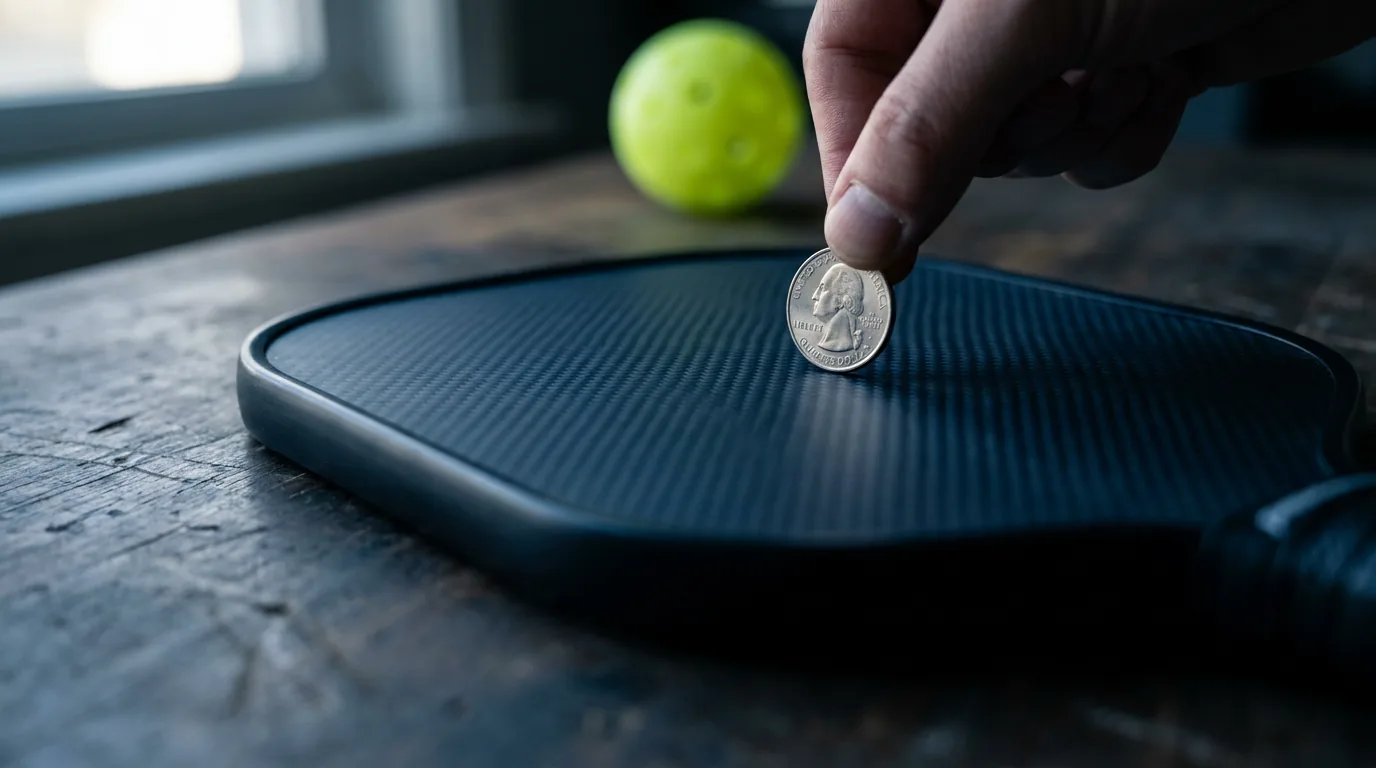
This is the standard check. A healthy core and a dead core sound different through the same face.
Tap the face with a coin or a knuckle, starting at the top edge and working down in a grid, with about two centimetres between taps.
A healthy face gives the same crisp, hollow tick everywhere. A dead area sounds dull and flat, more like tapping a table.
Mark dull patches with a pencil or sticky notes so you can see their size and position.
A small dull patch near the edge can still play fine for a while. A dull patch centred on the sweet spot usually means the paddle is done for competitive play.
Lay the paddle flat on a table and press the face with your thumb, using moderate pressure, in the same grid. A healthy face feels even and slightly springy.
A soft crease, a click or a floating feel points to a broken core or a lifted face sheet. Press along the throat and shoulders too, because edge failures often start where the moulding meets the face.
On thin-faced paddles the difference can be hard to feel, so treat the press as a second opinion after the tap.
A healthy paddle makes the same clean knock on every drive. A tired core sounds duller and more hollow, and the sound varies from hit to hit because different parts of the face are in different states.
Check it on purpose. Hit twenty balls from the same spot and listen, then borrow a known good paddle, hit twenty more and compare.
Paddletek suggests the same side-by-side idea: play a few points with a newer paddle of similar specs and watch for power, spin and sound. If yours is clearly flatter, the core is telling you something.
Hold the handle in one hand and grip the face near a top corner with the other, then gently try to twist. A little flex is normal. A creak, crack or shifting feeling means the layers are separating.
Check the handle and throat too. Hold the handle in one hand and the throat in the other and try a gentle bend. Looseness at the joint between handle and face is a structural problem, and Paddletek lists cracks and loose edge guards among the signs a paddle is done.
| Symptom | Likely cause | What to do |
|---|---|---|
| Dull, flat patch when tapped | Core cells crushed, or the face separated from the core | Mark it. Over the sweet spot, replace the paddle. Small and near an edge, keep watching it. |
| Soft spot or click under your thumb | Broken core or a lifted face sheet | Press the same spot again. If it repeats, treat it as a dead zone. |
| Creak, crack or shifting when twisted | The bond between layers is failing | Stop using it for serious play and check the handle and throat joint. |
| Ball dies in the same spot on the face | A local dead zone | Run the coin tap on that spot and compare with a known good paddle. |
| Muted, uneven sound in play | Core losing rebound unevenly | Hit the same shots with another paddle and compare the sound and pop. |
| Bubbling or lifting on the face or edge guard | Delamination | Replace it. Paddletek lists delamination and cracks among signs the paddle is done. |
| Spin has faded and the face feels smoother | Surface texture worn down | Clean the face and compare. Paddletek says worn texture cannot be rebuilt. |
| Only scratches and edge scuffs | Cosmetic wear | Keep playing. Paddletek says these do not affect performance. |
There is no fixed number, because wear follows hits, not months.
Paddletek’s own guidance is that casual players can get several years from a quality paddle, while players at three to five sessions a week should expect to replace one every 6 to 18 months. Hard hitters who play daily may go through paddles faster.
Heat shortens that. Revolin, another paddle maker, warns that prolonged heat, such as a paddle left in a hot car, can make the composite break down faster. A bag and some shade between games cost nothing.
Bring a coin and tap the whole face before any money changes hands. Walk away from a dull patch.
Press the sweet spot and the throat, check the edge guard for lifting, and look for hairline cracks or bubbling near the throat.
Ask how often it was played and how it was stored. Hits wear a paddle out, so a short history of daily play can matter more than a long one of weekly games.
Replace the paddle when a dull spot sits over the sweet spot, when the sound is flat across the whole face, when the laminate creaks, or when you can see cracks or delamination.
If the only symptom is a scratch or an edge scuff, keep playing. Paddletek says cosmetic scuffs and minor scratches do not affect performance.
Do not count on a repair. Paddletek says a worn core cannot be restored. A paddle that passes the tap and press checks still has its pop, whatever the calendar says.
Related guides: the grip size guide, because a badly fitted grip can feel like a dead paddle, and the training aids article, which covers practice tools that make a side-by-side comparison fair.
Tap the face with a coin and listen for a dull, flat patch among crisp taps. Press the face for a soft spot, twist it for a creak, and watch for shots that die in the same place. Bubbling or lifting on the face points to delamination. One sign alone can mislead; two together usually confirm it.
Paddletek says a core that has lost its rebound cannot be restored, and that worn surface texture is also permanent, so replacement is the fix once performance drops. It also says a cracked face or edge guard means the paddle is done, because cracks can spread under repeated impact.
Paddletek says casual players can get several years from a quality paddle, while players at three to five sessions a week should expect to replace one every 6 to 18 months. Competitive players who hit hard and play daily may go through paddles even faster. Hits matter more than months.
Yes. Paddle maker Revolin warns that prolonged heat, such as a paddle left in a hot car or in direct sun, can make the composite break down faster. Keeping the paddle in a bag, out of the car and out of the sun between games is the simple precaution.
Tap the whole face with a coin and walk away from any dull patch. Press the sweet spot and the throat, check the edge guard for lifting, and look for cracks or bubbling. Ask how often it was played and how it was stored, because hits matter more than age.
Last updated: November 1, 2026