How Long Do Pickleballs Last? Ball Lifespan, Cracks and the Retire-It Test
A pickleball is a hollow plastic shell, and it wears out on a schedule most players never think about. Outdoor balls crack. Indoor balls…
A pickleball is a hollow plastic shell, and it wears out on a schedule most players never think about. Outdoor balls crack. Indoor balls…
A pickleball is a hollow plastic shell, and it wears out on a schedule most players never think about. Outdoor balls crack. Indoor balls go soft. Both failures change how the ball flies long before the ball looks broken, and playing a dead ball past its useful life quietly wrecks your control and your confidence. Here is how long a ball actually lasts, what kills it, and how to tell when it is time to retire one.
There is no official expiry on a pickleball, because the rulebook governs dimensions, bounce and hole count, not durability. In practice the numbers look like this.
An outdoor ball used for competitive rallies lasts roughly 8 to 12 hours of play. Casual play stretches that further, maybe 15 to 20 hours, because fewer hard drives and fewer errors mean fewer violent impacts. That works out to about one to three sessions per ball for most club players. Higher-end outdoor balls made from more durable moulded plastic can run several times longer. Cheap bulk balls crack in a single hard session.
Indoor balls last longer, often weeks of regular play, because the game is softer, the surface is friendlier and the ball is more pliable. They do not usually crack. They soften, the bounce drops, and one day you notice your serves are dying at the kitchen line with a swing that was fine last week.
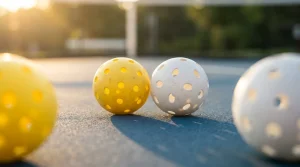
Outdoor balls fail by cracking, usually along the mould seam or between two holes where the plastic is thinnest. Every hard drive and overhead puts the shell under stress, and the plastic fatigues like any other material. The first sign is often a sound change: a cracked ball has a dull, rattling report you can hear from the next court. Some cracks stay invisible until you squeeze the ball gently and feel one side give.
Cold is the big accelerator. Below about 10 degrees Celsius the plastic gets brittle and a ball that would last a week in summer cracks within a session. Clubs in cold climates go through dramatically more balls in January than in July. If your winter sessions are outdoors, buy more balls than you think you need and store them somewhere warm before play.
UV does its share too. Balls left on an outdoor court for weeks fade and the plastic degrades; a ball that has spent a full Gulf summer in a net bag in the sun will not last like one kept in a bag in the shade.
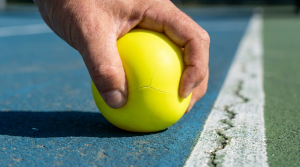
Indoor balls go soft rather than crack. The more pliable plastic takes thousands of impacts, slowly loses its shape memory, and the ball stops bouncing true. The classic test is the squeeze: press a new ball between your fingers, then press one from your club’s old basket, and you will feel the difference in stiffness immediately. A soft ball sits down on serves, refuses to carry on drives, and responds oddly to spin.
Bounce test on a hard floor: drop a new ball and a suspect ball from shoulder height side by side. The worn one bounces noticeably lower. That is your retirement signal.
Two storage habits kill balls faster than play does.
First, the hot car. A car interior in summer sun easily passes 60 degrees Celsius. Hollow plastic balls deform under heat, and a ball that has spent an afternoon on the back seat can come out slightly oblong, which is illegal under the rulebook’s roundness requirement and plays inconsistently. Keep balls in a bag, in the shade, and never in a parked car.
Second, pressure. Stacking heavy gear on top of a ball bag compresses the balls and accelerates the softening that ends an indoor ball’s life. Balls are cheap; the bag does not need to be the bottom of the equipment pile.
Retire a ball the moment it shows any of these: a visible crack, a rattle or dull sound on impact, a soft feel in the squeeze test, an obviously lower bounce than a fresh ball, or a warped, oblong shape. None of these are worth playing through. A dead ball distorts every shot you hit with it, and you will adjust your swing to compensate, which is the exact opposite of what you want from practice.
The habit that works: keep two balls in play, one fresh, one older, and use the fresh one for games while the older one dies in warm-up drills. Retired balls are still fine for footwork drills and serve practice against a wall.
Outdoor balls sell in packs, and quality ones cost a few dollars each. If a mid-tier outdoor ball lasts ten hours, and you play four hours a week, you are spending roughly one ball per two to three sessions. That is the cheapest consumable in any racquet sport by a wide margin. Trying to save it by squeezing extra sessions out of dead balls costs far more in ruined practice than the ball is worth.
If you play tournaments, retire balls early and practise with the exact ball type the event uses; equipment familiarity matters, and how paddle weight and swing shape interact with ball speed is covered in our guide to paddle weight and swing speed. If your shots have gone strangely flat and you have ruled out technique, check the paddle too: the quick tests for a dead paddle face are in our piece on spotting a dead spot before you blame your technique.
Buy decent balls, store them sensibly, retire them early. It is the cheapest upgrade in the sport.
Last updated: October 24, 2026