Best Control, Power and Spin Pickleball Paddles by Play Style
Choose a control, power or spin pickleball paddle with a style picker, a core, face and weight table from maker pages, and verified Amazon picks by play style.
Choose a control, power or spin pickleball paddle with a style picker, a core, face and weight table from maker pages, and verified Amazon picks by play style.
Quick answer
Makers describe control paddles by thicker cores, power paddles by thinner cores and spin paddles by textured carbon faces. Paddletek says thicker cores favor control, thinner cores favor power, and elongated shapes add reach and spin. Selkirk separates power, how a paddle hits a slow ball, from pop, how it answers a fast one.
Say where your points end, what you want the paddle to add and whether your arm is sore. You get a control, power or spin match drawn from maker guidance, plus an example paddle.
This is guidance built from named maker sources, not a test result. Maker claims about spin and power are claims, and a demo beats a spec sheet.
Specs come from each maker page. Amazon listings often combine several options, so each card says which one to choose. Paddlory earns a commission on qualifying purchases through these links, at no extra cost to you.
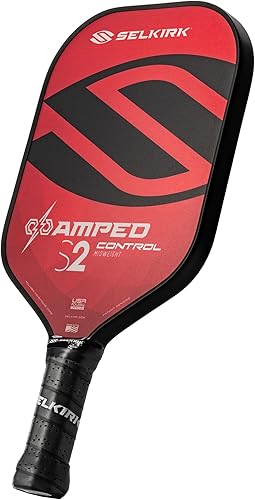
Control. Selkirk lists a 16 mm core, a fiberglass face and 7.3 to 7.8 oz lightweight or 7.9 to 8.4 oz midweight. The listing mixes shapes and weights, so choose Control, S2 and your weight.

Power. Selkirk lists a 13 mm core, a hybrid fiberglass and carbon face and 7.7 to 8.1 oz. The listing covers three lines, so choose Power Air, S2, Midweight.

Spin. CRBN lists a T700 raw carbon face, 7.8 to 8.1 oz, 16.5 by 7.25 in, in 14 or 16 mm. The listing mixes 1X, 2X and 3X, so choose CRBN1X and your thickness.
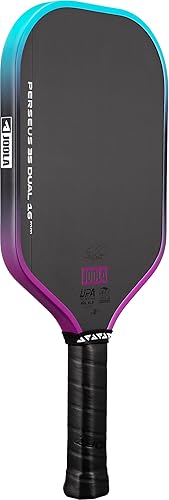
Control and spin. JOOLA lists a textured carbon face, 16 mm, 8.0 oz average and 16.5 by 7.5 in. The listing mixes shapes and thicknesses, so choose Perseus 16mm.
This four-minute video explains the difference between power and pop, and where hybrid paddles sit between control and power.
Every row comes from the maker page named in the last column.
| Paddle | Face | Core | Weight | Shape | Source |
|---|---|---|---|---|---|
| Selkirk AMPED Control S2 | Fiberglass FiberFlex+ with a durable spin coating | 16 mm | Lightweight 7.3 to 7.8 oz, midweight 7.9 to 8.4 oz | S2, 15.75 by 8 in | Selkirk product page |
| Selkirk Vanguard Power Air S2 | Hybrid fiberglass and carbon, four layer | 13 mm polymer honeycomb | Midweight 7.7 to 8.1 oz | S2, 15.75 by 8 in | Selkirk product page |
| JOOLA Perseus 3S Dual 16 mm | Textured carbon fiber | 16 mm | 8.0 oz average | Perseus, 16.5 by 7.5 in | JOOLA product page |
| CRBN 1X, X Series | T700 raw carbon fiber | 14 or 16 mm | 7.8 to 8.1 oz | Elongated, 16.5 by 7.25 in | CRBN product page and comparison chart |
| Style | What makers say | Source |
|---|---|---|
| Control | Thicker cores favor control. JOOLA says choose 16 mm for added control and forgiveness. Standard shapes give a bigger sweet spot | Paddletek buying guide, JOOLA product page |
| Power | Thinner cores favor power. JOOLA says 14 mm gives a faster, more responsive feel. Selkirk calls power the feel on a slow or resting ball and pop the answer to a fast one | Paddletek buying guide, JOOLA product page, Selkirk video |
| Spin | Elongated shapes add reach and spin with a smaller sweet spot. Texture smooths with ball contact, and spin is usually the first thing to fade | Paddletek buying guide and care guides |
| Limits | USA Pickleball caps spin at 2,100 RPM for paddles submitted from 1 October 2026. Earlier certified paddles stay under the standards in effect when they were certified | USA Pickleball spin rate test update |
These are maker descriptions. Paddletek, JOOLA and Selkirk each describe their own paddles, so treat the claims as claims and demo a paddle when you can.
If your errors are nets and pop-ups at the kitchen line, start with control. Selkirk says the S2 shape has the largest sweet spot of its shapes, and Paddletek says standard shapes give a bigger sweet spot.
If you lose rallies because balls sit up and you cannot finish them, start with power. If you are short on topspin and slice, start with a textured carbon face and an elongated shape, and expect that texture to wear.
Weight changes the feel of all three. Our paddle weight guide covers the bands, and core thickness guide covers how thickness changes the paddle.
To compare the three makers directly, read Selkirk vs JOOLA vs CRBN. For ranked picks at your level, see the best paddles for intermediate players.
Related specs: paddle shape, face material and grip size. For the full buying guide, see how to choose a paddle and the best paddles ranked.
Planning to compete? Check the paddle against the approved paddle list first.
We did not test these paddles. Specs come from the Selkirk, JOOLA and CRBN product pages. Style guidance comes from the Paddletek buying guide and care guides and the Selkirk power versus pop video.
The spin cap comes from the USA Pickleball spin rate test update. Pages were read in November 2026. We removed earlier unsourced claims about measured RPM, dwell time and independent testing.
Paddletek says thicker cores favor control and standard shapes give a bigger sweet spot. JOOLA says choose its 16 mm for added control and forgiveness. Selkirk lists the AMPED Control S2 with a 16 mm core. Demo if you can, because feel is personal and spec sheets are maker claims.
Paddletek says thinner cores favor power, and JOOLA says its 14 mm feels faster and livelier than its 16 mm. Selkirk lists the Vanguard Power Air S2 at 13 mm and calls it the top choice for power players. Power is a feel claim, so demo before you commit.
Selkirk says power is how a paddle hits a slow or resting ball, such as a serve or a floating putaway. Pop is how it answers a ball that already has pace, such as a counterattack or a return. A paddle can be strong at one and average at the other.
Makers say textured carbon faces and elongated shapes help. CRBN claims industry leading spin and dwell time for its T700 raw carbon face, and Paddletek says elongated shapes add spin. Those are maker claims, and Paddletek notes the texture smooths with use. USA Pickleball caps spin at 2,100 RPM for newly certified paddles.
Hybrid designs aim at the middle. Selkirk describes paddles between control and power as hybrids, and JOOLA says its 16 mm Perseus offers added control with a textured carbon face. No source here measures an all-round winner, so pick the style that fixes your most common error and demo from there.
Only for sanctioned tournament play. USA Pickleball says decertification applies only to sanctioned tournaments, and recreational players can still use those paddles. If you may enter events, check the model on the official approved paddle list before you buy, because entries are listed per variant.
Last updated: November 2, 2026