Best Pickleball Paddles Ranked by Core, Face and Weight
Five pickleball paddles ranked by core thickness, face material and weight, with specs from the makers and a Check price link where we verified the listing.
Five pickleball paddles ranked by core thickness, face material and weight, with specs from the makers and a Check price link where we verified the listing.
The best pickleball paddle for you depends on how you play, not what a pro endorses. We organized the top picks by play style and budget using real manufacturer specs.
Paddlory earns a commission on qualifying purchases through the Amazon links on this page, at no extra cost to you. Picks are chosen on performance and suitability, not on commission.
The Perseus 3S uses a carbon fiber face over a 16mm foam-injected core. The thicker core absorbs impact and gives you dwell time for soft dinks and precise placements. At 8.0 oz, it is stable without being sluggish.
Selkirk describes the Power Air as built for power and spin. It combines Selkirk‘s QuadFlex hybrid face, two Fiberflex layers and two Quantum+ carbon layers, with an open ThroatFlex design that Selkirk says extends dwell time. It is a midweight paddle at 7.7 to 8.1 oz, and the Amazon listing is the S2 standard shape.
Prices move, and stock does too. Each of these opens the product page on Amazon in a new tab. There is no button for the Engage Pursuit MX 6.0 because we could not verify an Amazon listing for that exact model.
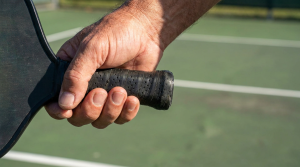
Grip circumference from height is the standard fitting shortcut, and it is a starting point, not a measurement. Measure from the middle crease of your palm to the tip of your ring finger and trust that number over the chart if the two disagree. A grip that is slightly small can be built up with an overgrip. One that is too large cannot be fixed.
CRBN markets its raw carbon fiber face as a spin surface, and we did not test that claim. The 16mm thermoformed core with foam-injected edges extends the sweet spot and reduces vibration.
The Bantam EX-L is the budget pick. Paddletek lists it at $89.99 on its own store (checked November 2026). It is a widebody paddle with a 12.7mm Bantam PolyCore, a static weight of 7.8 to 8.4 oz and a polycarbonate face.
The Pursuit MX 6.0 splits the difference between control and power with a 15.2mm core, a raw carbon face and an elongated shape. It does not excel in any one area, but it does everything well. A safe choice for players who have not locked in a play style yet.
Keep reading: how to choose a pickleball paddle.
Specs as published by each maker. Prices change, so each button opens the current Amazon listing.
| Paddle | Weight | Core | Face | Shape | Amazon |
|---|---|---|---|---|---|
|
Perseus 3S 16mm
JOOLA
Top Pick |
8.0 oz | 16mm | Carbon Fiber | Elongated | Check price |
|
Vanguard Power Air
Selkirk
|
7.7 to 8.1 oz | 13mm | Fiberglass/Carbon | Standard (S2) | Check price |
|
CRBN 1X
CRBN
|
8.1 oz | 16mm | Raw Carbon Fiber | Elongated | Check price |
|
Bantam EX-L
Paddletek
|
7.8 to 8.4 oz | 12.7mm | Polycarbonate | Widebody | Check price |
|
Pursuit MX 6.0
Engage
|
8.2 oz | 15.2mm | Raw Carbon Fiber | Elongated | No verified listing |
For intermediate players who want one paddle that does everything well, the Engage Pursuit MX 6.0 or JOOLA Perseus 3S 16mm are the safest choices. Both offer balanced performance across control, power, and spin.
Prices vary widely by maker and change often, so use the Check price buttons for current figures. As a reference, Paddletek lists the Bantam EX-L at $89.99 and CRBN lists the 1X 16mm at $149.99 on their own stores (checked November 2026). Beginners do not need a flagship paddle.
There is no single best brand. JOOLA markets its paddles on tour-level performance, CRBN markets its raw carbon faces for spin, Selkirk sells a wide range of shapes and weights, and Paddletek's Bantam EX-L is the budget pick on this page. Match the core thickness and shape to how you play, then compare brands.
Last updated: October 31, 2026