Pickleball Balls: Indoor vs Outdoor, Explained
How pickleball balls differ: the 26 to 40 hole range, indoor versus outdoor, wind and approval, plus a quick check that your ball suits where you play.
How pickleball balls differ: the 26 to 40 hole range, indoor versus outdoor, wind and approval, plus a quick check that your ball suits where you play.
Quick answer
A pickleball is defined by its holes. USA Pickleball allows 26 to 40, and the larger-holed ball is customarily the indoor one. Franklin’s X-26 has 26 holes for wood and composite floors, and its X-40 has 40 holes for outdoor courts. Count the holes on the ball you use before you buy another.
Say where you play, how many holes your ball has and how windy it is. You get a verdict and what the rulebook and makers say.
This is guidance from the USA Pickleball rulebook and maker pages, not a test result. For specific picks, use the picker in our balls guide.
Each card shows one maker example of a kind of ball. Specs come from the maker page or the Amazon listing text. Paddlory earns a commission on qualifying purchases through these links, at no extra cost to you. For ranked picks, see our best pickleball balls guide.
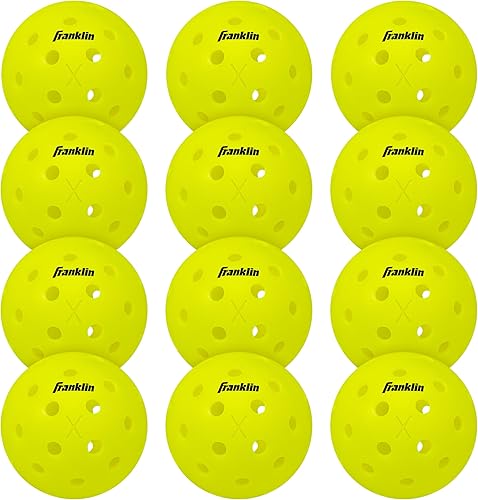
Franklin prints 40 machine-drilled holes and a one-piece build for concrete, asphalt and other outdoor surfaces. The listing gives 26 g and 74 mm.

Franklin prints 26 holes and a two-piece build, optimized for wood and composite surfaces. The listing gives 24 g and 74 mm.

Onix prints seam welding that resists splitting, and says the ball creates consistency between the indoor and outdoor game. Onix lists it as meeting USAPA requirements.
Not in stock on Amazon as of 1 Nov 2026.

Onix prints smaller holes and heavier weighting to cut the effect of wind. Onix lists it as not meeting USAPA requirements, so it is for casual play.
This three-minute video explains how indoor and outdoor balls differ and then runs through six popular outdoor balls.
| Kind | Holes | Example | Built for | Approval | Source |
|---|---|---|---|---|---|
| Outdoor | 40 | Franklin X-40 | Concrete, asphalt and other outdoor surfaces | USA Pickleball approved for outdoor tournament play, per Franklin | Franklin product page |
| Indoor | 26 | Franklin X-26 | Wood and composite surfaces | USA Pickleball approved for indoor tournament play, per Franklin | Franklin product page and Amazon listing |
| Seam-welded indoor | Not printed | Onix Fuse Indoor | Indoor play, with consistency outdoors per Onix | Onix lists it as meeting USAPA requirements | Onix product page |
| Wind-weighted outdoor | 40 per the Amazon listing | Onix Pure 2 | Outdoor wind | Onix lists it as not meeting USAPA requirements | Onix product page and Amazon listing |
The USA Pickleball equipment standards require a minimum of 26 and a maximum of 40 circular holes. Within that range the count and size vary by design.
Onix patents a 40-hole pattern that mixes large and small holes on the Dura Fast 40. Franklin describes its 26 and 40-hole balls as giving a balanced flight pattern.
Our guide to how many holes a pickleball has goes through what the count means for flight. The official size, weight and bounce figures are in the rules section of our balls guide.
Rule 3.C.1 of the USA Pickleball rulebook says all approved balls are acceptable for indoor or outdoor play. It then notes that the ball with larger holes is customarily used indoors and the ball with smaller holes outdoors.
So an outdoor ball on a gym floor is legal, and so is an indoor ball outside. The makers still design for a setting, and the difference shows on rough surfaces. For the on-court effect, read indoor versus outdoor balls.
The maker answers to wind are weight and hole size. Onix prints heavier weighting and smaller holes on the Pure 2, and calls the Dura Fast 40 the fastest ball in the sport.
The Pure 2 is listed as not meeting USAPA requirements, so it is not a tournament ball. If you play in wind and enter events, check the approved list before you buy.
Franklin says its X-40 performs best on authentic pickleball courts and in average temperatures, and that its no-seam one-piece build resists dents and cracking. Onix says seam welding on the Fuse and Pure 2 resists splitting.
No maker prints a cutoff temperature or a standard lifespan. The Dura listing says 3 to 10 games in tough conditions, so keep spares. See balls for cold weather, how long pickleballs last and how to tell if a pickleball is cracked.
For a sanctioned tournament the ball must be named on the official USA Pickleball approved list. A ball intended for competition must carry the maker name and the USA Pickleball Approved seal on its packaging.
Maker pages vary in what they print, so check the list. Once you know the kind of ball you need, our best pickleball balls guide ranks specific picks.
If you are setting up a court, the best portable pickleball net guide covers the net, and the best pickleball paddle guide covers the paddle.
We did not test these balls. Rules come from the USA Pickleball rulebook and equipment standards, and ball details are what the Franklin and Onix pages and the Amazon listings say.
Onix prints no weight for several of its balls, and approval wording changes. We show no prices because they change daily.
Yes. Rule 3.C.1 of the USA Pickleball rulebook says all approved balls are acceptable for indoor or outdoor play, and larger holes are only customary indoors. Franklin does optimize its 26-hole X-26 for wood and composite floors, so an indoor ball is the closer match for a gym.
The rulebook allows it for any approved ball. Franklin builds its X-40 in one piece for concrete, asphalt and other outdoor surfaces, and optimizes its two-piece X-26 for wood and composite. On a rough outdoor court, the ball the maker designed for it is the safer choice.
It is a design choice by the maker. Franklin builds its outdoor X-40 in one piece with no seam, which it says resists dents and cracking, and its indoor X-26 in two pieces. Onix welds the seam on its Fuse and Pure 2, which it says resists splitting.
Onix prints smaller holes and heavier weighting on its Pure 2 to cut the effect of wind. It lists that ball as not meeting USAPA requirements, so it suits casual play. For sanctioned events, choose an approved 40-hole ball and check the list first.
For a sanctioned tournament the ball must be named on the official approved list on the USA Pickleball site. The equipment standards also require competition balls to show the maker name and the USA Pickleball Approved seal or text on the packaging.
Makers print no cutoff temperature. Franklin says its X-40 performs best on authentic pickleball courts and in average temperatures, and Onix says seam welding on its Fuse and Pure 2 resists splitting. If a ball cracks, retire it, and keep spares if you play in conditions the maker does not rate.
Last updated: November 1, 2026