Pickleball Bags for Men: Capacity vs Bulk
Choosing a pickleball bag for men: six-paddle tour bags vs backpacks and slings, shoe compartments, listed specs, and how to avoid overpacking your kit.
Choosing a pickleball bag for men: six-paddle tour bags vs backpacks and slings, shoe compartments, listed specs, and how to avoid overpacking your kit.
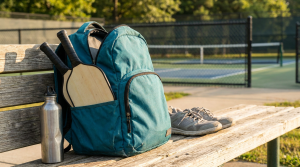
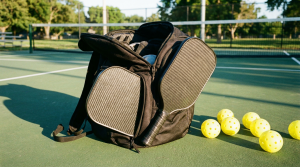
Buy the smallest bag that holds your real kit, not the biggest one that looks serious. For most men playing two or three sessions a week, that means a backpack with a 3-paddle sleeve and a shoe compartment. A six-paddle tour bag only earns its bulk if you actually rotate paddles or play all-day events.
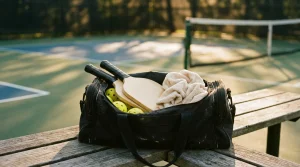
The capacity jump is bigger than the weight jump. On manufacturer figures, the CRBN Pro Team Tour Bag 2.0 lists 3 lb against 3.2 lb for the Pro Team Backpack 2.0, but its outer dimensions are roughly double in box volume. That extra depth is what you feel in a car trunk, a locker, and on a crowded court fence.
Video: Pickleball Blast
Ask one question first: how many paddles do you swing in a normal week? If the answer is one, plus a spare, a three-slot sleeve already has room to spare. Our guide to how many paddles fit in a pickleball bag breaks down slot counts by format.
Slings sit at the other end. They carry paddles, a few balls, a phone and keys, and not much more. The trade-off between the two carry styles is covered in pickleball backpack vs sling bag.
Men’s court shoes in larger sizes take up real volume, and they come off the court with grit and sweat. A separate compartment keeps that off your paddle faces and your change of clothes.
This is the line slings rarely cross. The CRBN sling lists no shoe compartment at all, while the backpack puts one at the bottom and the tour bag lists a vented one. If you change shoes at the court, rule slings out before you compare anything else.
| Bag | Format | Listed paddle capacity | Shoe compartment | Listed dimensions | Listed weight | CRBN-site price |
|---|---|---|---|---|---|---|
| CRBN Pro Team Sling Bag | Sling | "Multiple paddles", no count listed | None listed | 20 x 11 x 5.5 in | 1 lb 15 oz | $59.99 |
| CRBN Pro Team Backpack 2.0 | Backpack | Up to 3 in the back compartment | Yes, bottom compartment | 19 x 12.5 x 7.5 in | 3.2 lb | $149.99 |
| CRBN Pro Team Tour Bag 2.0 | Tour backpack/duffle | Up to 6, 3 per side pocket | Yes, vented | 23 x 12 x 14 in | 3 lb | $139.99 |
Figures come from CRBN’s own product listings, checked 17 September 2026. Prices are brand-site street prices and move with promotions. We picked one brand so the formats compare like for like.
A big bag fills itself. Six paddle slots invite three paddles you never touch, a second pair of shoes, and a can of balls you forgot about in June. Every item adds weight to the walk from the car.
Extra paddles also sit in heat. A thermal-lined pocket helps, but a paddle you are not using is still exposed to trunk temperatures for no benefit.
If you still land on a full tour bag, compare it against the wider field in our best pickleball bag roundup before you pay.
Size the bag to your session kit, not your gender. If you carry one or two paddles, balls, a bottle, and court shoes, a backpack with a 3-paddle sleeve and a shoe compartment covers it. Move up to a six-paddle tour bag only if you rotate several paddles or spend full days at tournaments.
They are worth it for tournament players and coaches who carry spares for others. For recreational play they mostly add bulk. On CRBN's listed specs, the Tour Bag 2.0 weighs about the same as the Backpack 2.0 but is far deeper, so the cost shows up in storage space rather than on the scale.
Usually not. Slings are built for paddles, balls, and small personal items, and the CRBN Pro Team Sling Bag lists no shoe compartment. If you change shoes at the court, a backpack or tour bag with a separate compartment keeps dirty soles away from your paddles.
Last updated: October 24, 2026